When I started this research project, I really wanted to answer the question of whether having cisgender actors/characters crossdress in a more performative way was ever okay. I realize that is an extremely complexed and nuanced question to answer in a generalized manner, which is why my takeaway is less all-encompassing and more of a lens to view entertainment in. I think the ethical question of crossdressing portrayals in film come down to power hierarchies.
Most of the literature I found about the subject of crossdressing in comedy was critical about men crossdressing as woman. I discovered less critiques on woman crossdressing as men within comedy. I believe this is because of the inherent gender power dynamics at play. In the cases where women crossdressed as men, it was to achieve something that men had access to, but women did not. In She’s the Man, Viola crossdresses as her brother Sebastian in order to join the soccer team at an all-boys school, because the women’s team got cut. In Mulan, Mulan wants join the army, but women are not allowed to, so she crossdresses as a man as the only avenue to join. While some might find humor in “women in suits,” there is more legitimacy in the cause because they are exchanging their femininity for power by joining the traditionally superior gender and the resources they have. In order for women to gain power, they sometimes have to resort to channeling more traditionally-viewed masculine personas or characteristics, such as being assertive or aggressive in the workplace to gain respect. This is why a woman in a suit might receive less absurdity from an audience. On the other hand, the cases where men crossdress as women have more humor involved because they forfeit their masculine privilege to join a more “inferior” gender, with potentially less social and structural resources. This means that the reasons for crossdressing are for more leisurely reasons, such as connecting with a female love-interest via a feminine “disguise.” They temporarily sacrifice their heteronormative masculinity for a short duration of time by wearing dresses and makeup to obtain an aspect that will enhance their heteronormative masculinity, such as acquiring a girlfriend. This is perceived as more funny, because of how fragile toxic masculinity is, so anything that disrupts that must be a joke.
However, again, these fictional portrayals of crossdressing do not replicate real life. In the real world, transgender women face the most backlash and extreme violence for their identity. The main distinguishing factors between these fictional cases I viewed and real life being legitimacy and time. Transgender women who transition from male to female do not have an “unveiling” because their transitions are permanent, not some temporary stunt to achieve some goal. Additionally, by constantly portraying male-to-female crossdressing characters in comedy, these films help reinforce the belief that masculinity will trump at all costs. Any deviation should be only temporary and for comic purposes before resuming to their masculine origins.
Additionally, the way these films emphasize the masculine attributes cisgender male characters crossdressing as women attempt to mask, but struggle to and get called out for being less attractive makes it even harder for transgender women transitioning and feminizing their appearance to be viewed in the same light as their cisgender counterparts. These films make it easier to ridicule feminine appearances that have more masculine features, which puts transgender women who might not have access or the desire to alter certain features at a greater risk.
While I tended to look at films focused on “crossdressing as a disguise,” in my conclusion I wanted to look at more modern examples where actors are crossdressing directly as characters of a different gender than how they identify, such as on Saturday Night Live (SNL) where female actors like Kate McKinnon and Melissa McCarthy have played male characters like Justin Bieber and Sean Spicer. Additionally, I wanted to look at cases where male actors have directly played female characters like John Travolta as Edna Turnblad in Hairspray or Jamie Foxx as Wanda in In Living Color.
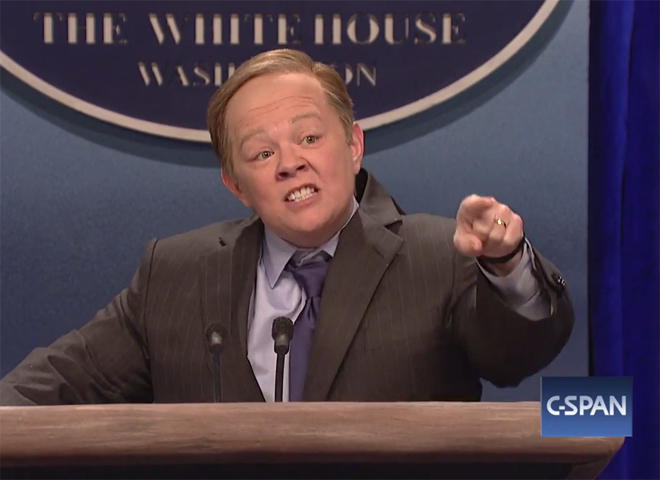
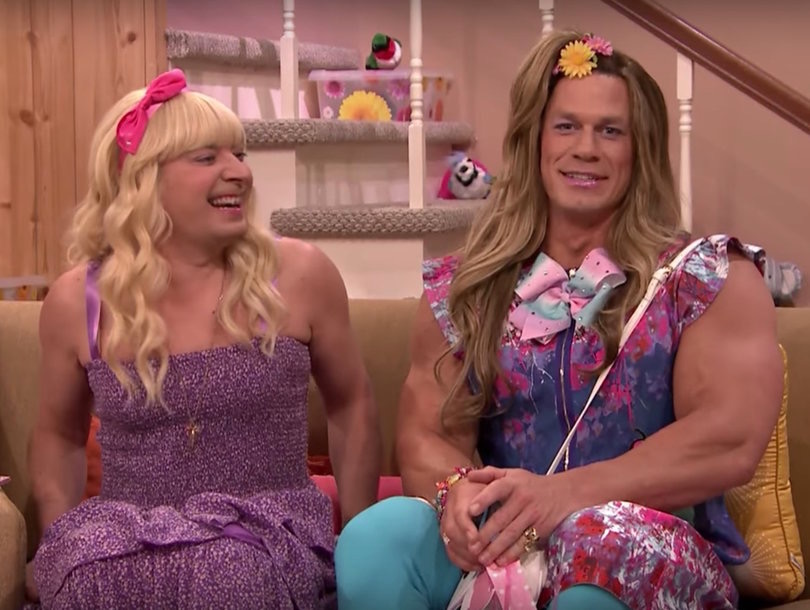
As I mentioned earlier, legitimacy and power dynamics are important. On SNL, the makeup and costume teams commit to Melissa McCarthy’s portrayal as Sean Spicer by having a full bald cap with no hair peaking through. However, in comparison, there are plenty of cases where men are supposed to be playing female characters but have blatantly apparent masculine physical attributes (such as facial hair, chest hair, or large muscles) peak through, such as Seth Rogen as a tween girl on The Tonight Show with Jimmy Fallon’s EW segment, which can be perceived as delegitimizing the performance and commitment to the role.
However, there are plenty of problems with this philosophy as well. It emphasizes a gender binary that people need to fully commit to appearances that are traditionally “feminine” or “masculine” and reduces the acceptance for gender fluidity in terms of expression. By assuming that male actors crossdressing as women should not have facial hair, it erases the exposure of men with facial hair who crossdress, women (trans or cis-) who might have a more masculine built or other qualities, and in general reinforces gender norms in terms of appearance.
As we have discussed in class, it is so difficult to deem people’s intentions when it comes to gender and sexuality identity and expression. Just like it is hard to judge whether musical artists are genuinely expressing themselves in more gender fluid ways or are trying to capitalize on a “gender-bending” trend, the intentions of crossdressing actors/characters and production teams are sometimes hard to determine completely. Additionally, the intentions might not align with the impact it has on its audience and transgender people it may affect. Because of this, there are a lot of limitations I feel my project had. For more thoughts on my reflections, please visit my Limitations page.
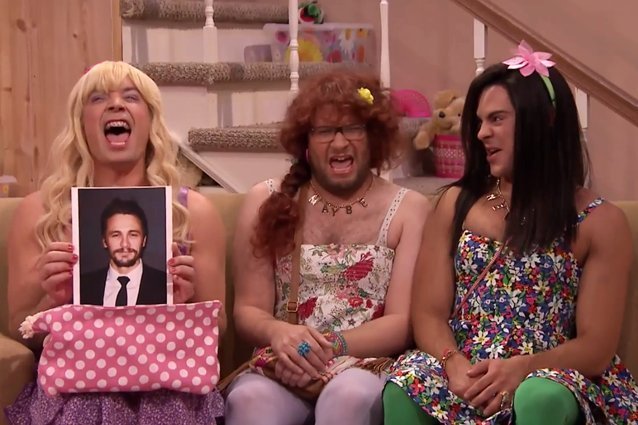
Audience viewers might laugh at Seth Rogen in a dress with a beard because they are experiencing appearances they might be unused to seeing, but does that mean these cases should stop? The context and platforms are important, but like most problems in Hollywood, representation needs drastic improvement. There need to be more representations of normalized crossdressing where these characters and qualities of characters are not the center or point of jokes. That, in addition to increased portrayals of transgender actors in both cisgender and transgender roles and more non-normative portrayals of masculinity, femininity, and gender expression.
 Cross Dressing in Comedy