Crossdressing as Comedy

During the 90s, politically correct culture started to gain more traction. It became more socially “taboo” to ridicule gay characters or people for jokes, so Hollywood turned to a different group. Crossdressers “fulfilled the same comic function as the effeminate gay, but without the now unfashionable character of direct ridicule of a sexual minority” (Phillips, 51). Audiences were now able to laugh at men in tights, assuming it was a heterosexual man. Crossdressing humor was considered politically acceptable, because most viewers assumed crossdressing was a temporary performance, not a permanent identity, which needed protection.

However, even before the 90s, progress narratives with crossdressing as a comic focus emerged. In most cases, people used crossdressing as a disguise to achieve some goal. Usually, these characters had heterosexual desires, which were impeded by the cross-dresser’s assumed identity. This was supposed to be humorous for the audience who is aware of their true identity and their desires, but “restrictions” from their current perceived gender, playing into the assumed heteronormative culture. The implication of these films were that crossdressing “can be ‘fun’ or ‘functional’ as long as it occupies a liminal space and a temporal time period” (Phillips, 53). Afterwards, the crossdresser is expected to resume life (sometimes having learned a lesson about masculinity or femininity).

In many comedy film cases, crossdressing is used a form of deception, which creates a great deal of comic misunderstandings. The audience knows their secret, while the other characters do not, which leads to audience pleasure from watching the deception unfold. Sharing secrets with the audience creates a sense of dramatic irony. This is supposed to make moments when a male character crossdressing as a woman gets sexually hit on by men funny, again, because of the assumption the man crossdressing is heterosexual.

The following are characteristics often found in these progress narratives on crossdressing:

  1. Unveiling (i.e. removal of a wig)
  2. Performance (supporting gender as performative)
  3. Forbidden Knowledge (privileged knowledge into how perceived gender thinks)
  4. Compulsory Heterosexuality (presumed identity poses as a hindrance to their sexual desires)
  5. Urinary Segregation (dilemma of what toilet to use in public creates a “comic” situation)
  6. A Temporary Transgression (because these films represent crossdressing instead of transgender or transsexuality, people’s deviation from their gender is viewed as temporary & harmless)

As I break down films, such as Tootsie, we will keep these characteristics in mind.

Takeaways

When I started this research project, I really wanted to answer the question of whether having cisgender actors/characters crossdress in a more performative way was ever okay. I realize that is an extremely complexed and nuanced question to answer in a generalized manner, which is why my takeaway is less all-encompassing and more of a lens to view entertainment in. I think the ethical question of crossdressing portrayals in film come down to power hierarchies.

Most of the literature I found about the subject of crossdressing in comedy was critical about men crossdressing as woman. I discovered less critiques on woman crossdressing as men within comedy. I believe this is because of the inherent gender power dynamics at play. In the cases where women crossdressed as men, it was to achieve something that men had access to, but women did not. In She’s the Man, Viola crossdresses as her brother Sebastian in order to join the soccer team at an all-boys school, because the women’s team got cut. In Mulan, Mulan wants join the army, but women are not allowed to, so she crossdresses as a man as the only avenue to join. While some might find humor in “women in suits,” there is more legitimacy in the cause because they are exchanging their femininity for power by joining the traditionally superior gender and the resources they have. In order for women to gain power, they sometimes have to resort to channeling more traditionally-viewed masculine personas or characteristics, such as being assertive or aggressive in the workplace to gain respect. This is why a woman in a suit might receive less absurdity from an audience. On the other hand, the cases where men crossdress as women have more humor involved because they forfeit their masculine privilege to join a more “inferior” gender, with potentially less social and structural resources. This means that the reasons for crossdressing are for more leisurely reasons, such as connecting with a female love-interest via a feminine “disguise.” They temporarily sacrifice their heteronormative masculinity for a short duration of time by wearing dresses and makeup to obtain an aspect that will enhance their heteronormative masculinity, such as acquiring a girlfriend. This is perceived as more funny, because of how fragile toxic masculinity is, so anything that disrupts that must be a joke.

However, again, these fictional portrayals of crossdressing do not replicate real life. In the real world, transgender women face the most backlash and extreme violence for their identity. The main distinguishing factors between these fictional cases I viewed and real life being legitimacy and time. Transgender women who transition from male to female do not have an “unveiling” because their transitions are permanent, not some temporary stunt to achieve some goal. Additionally, by constantly portraying male-to-female crossdressing characters in comedy, these films help reinforce the belief that masculinity will trump at all costs. Any deviation should be only temporary and for comic purposes before resuming to their masculine origins.

Additionally, the way these films emphasize the masculine attributes cisgender male characters crossdressing as women attempt to mask, but struggle to and get called out for being less attractive makes it even harder for transgender women transitioning and feminizing their appearance to be viewed in the same light as their cisgender counterparts. These films make it easier to ridicule feminine appearances that have more masculine features, which puts transgender women who might not have access or the desire to alter certain features at a greater risk.

While I tended to look at films focused on “crossdressing as a disguise,” in my conclusion I wanted to look at more modern examples where actors are crossdressing directly as characters of a different gender than how they identify, such as on Saturday Night Live (SNL) where female actors like Kate McKinnon and Melissa McCarthy have played male characters like Justin Bieber and Sean Spicer. Additionally, I wanted to look at cases where male actors have directly played female characters like John Travolta as Edna Turnblad in Hairspray or Jamie Foxx as Wanda in In Living Color.

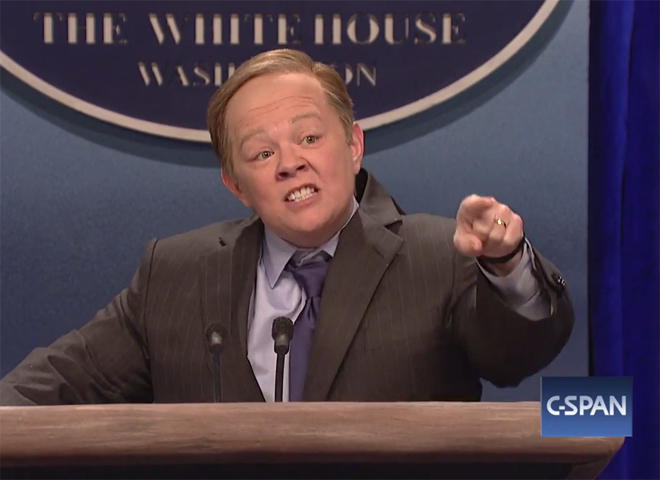
Melissa McCarthy as Sean Spicer on SNL

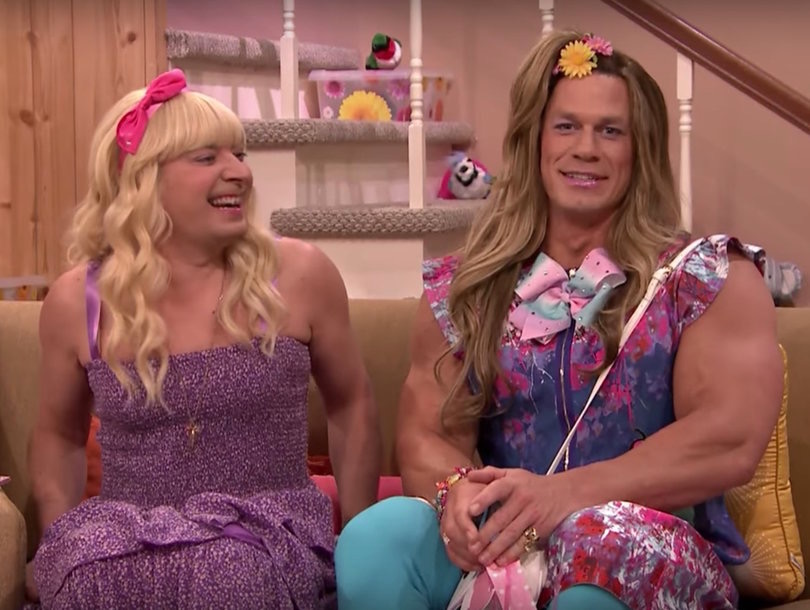
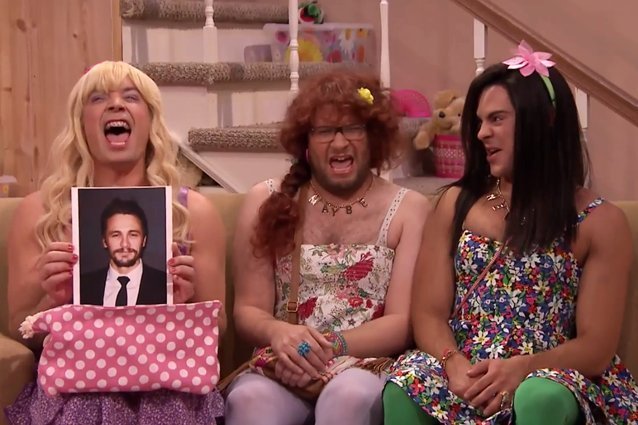
As I mentioned earlier, legitimacy and power dynamics are important. On SNL, the makeup and costume teams commit to Melissa McCarthy’s portrayal as Sean Spicer by having a full bald cap with no hair peaking through. However, in comparison, there are plenty of cases where men are supposed to be playing female characters but have blatantly apparent masculine physical attributes (such as facial hair, chest hair, or large muscles) peak through, such as Seth Rogen as a tween girl on The Tonight Show with Jimmy Fallon’s EW segment, which can be perceived as delegitimizing the performance and commitment to the role.

However, there are plenty of problems with this philosophy as well. It emphasizes a gender binary that people need to fully commit to appearances that are traditionally “feminine” or “masculine” and reduces the acceptance for gender fluidity in terms of expression. By assuming that male actors crossdressing as women should not have facial hair, it erases the exposure of men with facial hair who crossdress, women (trans or cis-) who might have a more masculine built or other qualities, and in general reinforces gender norms in terms of appearance.

A very muscular John Cena (R) with Jimmy Fallon (L) as tween girl on the segment EW!

As we have discussed in class, it is so difficult to deem people’s intentions when it comes to gender and sexuality identity and expression. Just like it is hard to judge whether musical artists are genuinely expressing themselves in more gender fluid ways or are trying to capitalize on a “gender-bending” trend, the intentions of crossdressing actors/characters and production teams are sometimes hard to determine completely. Additionally, the intentions might not align with the impact it has on its audience and transgender people it may affect. Because of this, there are a lot of limitations I feel my project had. For more thoughts on my reflections, please visit my Limitations page.

Jimmy Fallon, Seth Rogen, and Zac Efron as tween girls on the segment EW!

Audience viewers might laugh at Seth Rogen in a dress with a beard because they are experiencing appearances they might be unused to seeing, but does that mean these cases should stop? The context and platforms are important, but like most problems in Hollywood, representation needs drastic improvement. There need to be more representations of normalized crossdressing where these characters and qualities of characters are not the center or point of jokes. That, in addition to increased portrayals of transgender actors in both cisgender and transgender roles and more non-normative portrayals of masculinity, femininity, and gender expression.

Limitations & Reflections

I think identifying the limitations and flaws in my research is extremely important. Unfortunately, I did not get a chance to thoroughly study and analyze every topic I wanted to research, but I have developed a good basis for future research. Particularly, I would like to focus more on the frequent use of fat suits in these crossdressing roles, particularly when men are portraying female identities.

Additionally, and most importantly, I want to address that by comparing cases of male-identifying characters crossdressing as women and female-identifying characters crossdressing as men, I unintentionally may have reinforced a gender binary, which was very counterintuitive to my intentions and the work in our Trans Studies & The Politics of Visibility course. I hope that in highlighting what is most predominately visible in the media, I am also bringing attention to what is not visible and why.

One way to improve my limited scope upon further research is through a comparative study looking at cases not just in comedy films, but other genres. Cases of crossdressing where the gender identity of the characters or actors are more fluid and less normative, such as Hedwig and the Angry Inch.

This being said, I am happy that I picked a narrow topic focused specifically at comedy films, because there was a lot of literature around that correlation between humor, deception, and transgender identities that I was able to fully invest myself in.

Tootsie

In the film Tootsie, Dustin Hoffman plays a struggling actor named Michael Dorsey. Because Dorsey struggles to receive any work due to his poor reputation for being difficult to work with in the industry, he gets the inspiration to dress as a woman named Dorothy, so no one can recognize him, and audition for a role as a woman in a soap opera series. He gets the part because he plays a strong, assertive older woman, which his female friend was struggling to channel due to her softer demeanor when auditioning for the same role.

After receiving the part, Dorothy becomes a feminist icon both amongst her colleagues and across America with her improvisations on set and resilience to refuse any disrespect from the male characters with which she works. Dorothy particularly connects with her co-worker, Julie, whom Dorsey finds attractive.

For the following video, click on the top right-hand corner Playlist button and click on #6.

Relative to other crossdressing films at the time, such as Mrs. Doubtfire, Tootsie was perceived as more progressive at the time it was released. Dorsey actually comes to love and cherish his more feminine side through Dorothy, as shown by his fixation on enhancing her image via makeup, jewelry, and wardrobe. He takes his role as Dorothy very seriously and viewers can see his gradual infatuation with her by the way he invests so much time in her appearance, however, this is juxtaposed by Bill Murray’s character, Dorsey’s friend, who expresses his concern for this obsession taking over his masculine identity. The audience is seemingly supposed to side with Murray and laugh over the absurdity of Dorsey’s enjoyment in this role.

However, regardless of however genuine Dorsey’s connection to his more femininity is, it is undermined by his ulterior motives to pursue his co-worker Julie in a heterosexual romantic way, which emphasizes the compulsory heterosexuality conveyed in these films.

Additionally, as alluded to in my theory section, the audience is “allowed” to enjoy Dorsey’s fixation with Dorothy because it was a temporary transgression. The audience can take comfort in the fact that even though Dorsey becomes Dorothy, he is still a straight man behind the wig, makeup, and dress. It is harmless because at the end of the film, Dorothy reveals herself as Michael Dorsey and there is a sense of “normalcy” which is resumed. Dorsey is allowed to pursue Julie as a straight male.

It also worth noting that in a lot of these cisgender male characters crossdressing as women cases, these women are viewed as traditionally less attractive than their cisgender female counterparts, which is supposed to further empathize the notion of how “unnatural” and “abnormal” a male-to-female transition is. In some cases, such as Mrs. Doubtfire, they use fat-suits to further distinguish the natural beauty of cisgender characters to the forced beauty of their cross-dressing characters. This is because the more realistic and passable the drag is, the more credence is given to the character and the more it pushes heteronormative boundaries, which is controversial within Hollywood, especially in the 80s.

Literature Review

Bolsover, Nicola. “Costume and Cross-Dressing in Stand-up Comedy.” Master of Arts by Research (MARes) thesis. University of Kent, 2015. https://kar.kent.ac.uk/52927/1/230Thesis.pdf

In this thesis, I focus on the chapter “The Cross-Dresser,” which highlights the differences between male-to-female and female-to-male cross-dressers in the comedy sphere. According to her analysis, male-to-female cross-dressing elicits more of a comedic reaction because of the shame and self-humiliation that comes from men lowering their status to a more inferior position as a woman, which is perceived as ridiculous. Whereas when women cross-dress as men, it raises their traditional social status, which creates discomfort for the audience. While she acknowledges that this type of comedy is rooted in gender binary-based beliefs, it seems she fails to acknowledge the trans/queer perspective in this binary and humor, so I hope other sources will have a more nuanced analysis.

Barkhorn, Eleanor. “’Work It!’: Hollywood’s Cross-Dressing Double Standard Strikes Again.” The Atlantic. Atlantic Media Company, January 3, 2012. https://www.theatlantic.com/entertainment/archive/2012/01/work-it-hollywoods-cross-dressing-double-standard-strikes-again/250793/.

Barkhorn talks about the trope of men cross-dressing as women in comedies such as ABC show Work It! and Adam Sandler’s film Jack & Jill, and other slapstick comedies. The article includes a slideshow of many cross-dressing and cross-casting film posters. They cite Scott Meslow’s article where he acknowledges a cross-dressing double-standard in film: men dress as woman for “often crass comedies, whereas women dress as men for darker, more nuanced dramas.” While female-to-male cross-dressers tend to have more complex plots, male-to-female cross-dressing portrayals tend to derive laughs from the emasculation of those characters. Barkhorn also includes a recent example of Man Up! which elicited transgender advocacy groups protesting the show for perpetuating negative stereotypes regarding cross-dressing.

Braxton, Greg. “The Black-White Drag Divide: ‘White Famous,’ Chris Rock and Tyler Perry on Saying Yes to the Dress.” Los Angeles Times. Los Angeles Times, December 10, 2017. https://www.latimes.com/entertainment/tv/la-ca-st-humor-men-in-dresses-20171208-story.html.

In this piece for the LA Times, Braxton notes how male comedians appearing in drag seems to have universal appeal that crosses cultural lines, noting many black and white performers who have generated laughs by cross-dressing in sketch comedy and/or films. There are conflicting beliefs of what these representations mean for the image of black masculinity and that the decision to appear in a dress is more difficult than it is for white men. There have been mixed reviews on how people in the black community feel on the matter. Chris Rock stands with characters such as Tyler Perry’s Madea, and has expressed how “men dressing as women is a comedy staple, like a pie in the face.” While others believe that emasculating black men has close links to slavery and power structures where black men would need to appear less threatening. Braxton notes how Kenan Thompson took a stand on SNL in 2013 when he refused to play any female characters until the show hired black female cast members, which makes an important point about whether men, especially black men, are playing these roles out of choice or a “necessity” because they do not have a diverse cast. In this article, the debate about whether transgender roles should be played by non-transgender performers is included as an add-on, so I want to explore more literature where this is a focal point.

Champagne, Monica M. “Making Meatballs: Canadian Film and Television Comedy.” Order No. MR18243, Carleton University (Canada), 2005. https://search.proquest.com/docview/305006034?accountid=8505.

In this thesis, I focused on chapter three: “Taking It in the Face: Liberating the Unruly Woman in Kids in the Hall: Brain Candy.” This focuses on how the Canadian sketch comedy series Kids in the Hall, which star five male actors, incorporate drag performance into their comedy. Champagne uses gender theorists, queer theorists, and comedy scholars to argue that Kids in the Hall use mimetic drag to include women in areas of comedy they might have been excluded otherwise.

Hibberd, James. “GLAAD Slams ABC Cross-Dressing Comedy.” EW.com, December 16, 2011. https://ew.com/article/2011/12/16/work-it-controversy/.

Hibberd addresses how GLAAD called out new ABC sitcom Work It, a show about men dressing as women in order to get hired for jobs. GLAAD acting president Mike Thompson. “It will reinforce the mistaken belief that transgender women are simply ‘men pretending to be women,’ and that their efforts to live their lives authentically as women are a form of lying or deception.” While GLAAD acknowledged that the show does not explicitly mock transgender people, its goal is to elicit humor from men dressing up as women, which could promote audiences mocking those with actual gender-identity issues. Additionally, GLAAD took more issue with the ad promoting Work It showing men wearing women’s clothing at a men’s bathroom urinal, because it reinforces themes of deception and lying associated with transgender/cross-dressing people.

Pasternack, Dan. “Cross-Dressing at the Crossroads: A Brief History of Drag in Comedy.” pastemagazine.com, December 7, 2017. https://www.pastemagazine.com/articles/2017/12/cross-dressing-at-the-crossroads-a-brief-history-o.html.

Pasternack tracks the transition of the perception of cross-dressing popular culture. He notes how in 1948, Milton “Mr. Television” Berle often utilized the “reliable burlesque trope of putting a man in a woman’s dress” on his comedy variety series, The Texaco Star Theater, and compares that history to modern-day shows like RuPaul’s Drag Race, where drag is an identity to be embraced. He notes the comedic formula: straight men + women’s clothes + speaking in high-pitched voices = laughs. Anyone who crossed the binaries of masculinity and femininity would result in hilarity, citing Monty Python, The Kids in the Hall, and Saturday Night Live as sketch/variety comedy cases where mostly straight men “made gender-bending funny.” Some comedians who elicited laughs for inverting traditional perceptions around African-American masculinity include: Flip Wilson as Geraldine, Martin Lawrence as Sheneneh, and Jamie Foxx as Wanda. Pasternack ends with an optimistic take on how more modern-day examples like Melissa McCarthy as Sean Spicer and Louie Anderson as Zach Galifanakis’s mom on the FX series Baskets are more nuance than older drag caricatures. He also believes that regardless of our gender or sexuality, “our ability to find a common humanity in all means our cross-dressing comedy can and will go deeper than the dress.”

Phillips, John. “Cross-Dressing in Film Comedy.” In Transgender on Screen, 51–84. London: Palgrave Macmillan, 2016.

This chapter in the larger book Transgender on Screen focuses on cross-dressing acts as a comedic tool in comedy films. Phillips focuses on cross-dressing as a means of deception, which can lead to “comic misunderstandings.” He focuses on four main films during his analysis: Some Like it Hot (1959), Tootsie (1982), Victor/Victoria (1982), and Mrs. Doubtfire (1993). On the whole, the chapter focuses on transvestism as a temporary disguise in these films.

Rose, Steve. “What a Drag: the Death of the Cross-Dressing Movie.” The Guardian. Guardian News and Media, January 26, 2012. https://www.theguardian.com/film/2012/jan/26/what-a-drag-crossdressing-movies.

In this piece, Rose pinpoints Adam Sandler’s film Jack and Jill as “the moment when cinematic cross-dressing officially stops being funny.” He compares films that received awards by the American Film Institute as the Best American Comedy Ever Made in 2000, with Some Like It Hot in first and Tootsie in second versus now where drag is the “last resort of the lowest-aiming multiplex mass-market entertainer.”

Design a site like this with WordPress.com
Get started